
The short answer
Is corporate housing still a thing?
Very much — it just looks different. Companies still send people somewhere for a project, an assignment, training or a move, and they still need somewhere better than a hotel for the months that takes. More and more of that demand lands in individual furnished homes run by local operators. In our Phoenix homes, 50–70% of tenants at any given time are business travelers — travel healthcare workers, construction crews and project managers — and Furnished Finder says corporate travelers are now its largest tenant group, at 35% of booking requests.
The label covers a few different stays: an employee the company pays for directly, a relocating hire whose relocation company arranges the home, a consultant who books and expenses it, and a crew housed together for a job. They’re all midterm rentals; what changes is who signs and who pays. For the definition and how it compares with extended-stay hotels, see what corporate housing means.
How to start a corporate housing business
- Pick homes near the work. Hospitals, plants, job sites, campuses and business districts. A short commute sells a home to a company faster than a pool does.
- Furnish for someone who works from it. A real desk and chair, fast Wi-Fi, a full kitchen, laundry, parking, and utilities included in the rent. Corporate guests arrive with a suitcase and start work the next morning — see the furnishing checklist.
- Set up the business side. An entity, insurance that covers furnished rentals, any city or county registration your area requires, and a W-9 ready to send — companies ask for one before they pay a new vendor.
- Get a lease for 30+ night stays. Written or reviewed by a landlord-tenant attorney, with extensions, early termination and who may live there spelled out. What it should cover is in mid-term lease agreements.
- Decide how companies will pay you — online in a resident portal, by bank transfer, or by wire — and have an invoice ready for the ones that need one (our corporate housing invoice template is free).
- Price against comparable furnished homes. Use the federal per diem lodging rate for your area as a ceiling for a traveler’s budget, not as your price. Our mid-term rental calculator compares the home as a nightly, monthly and yearly rental.
- Get listed, and build your own site. See where to list mid-term rentals and direct booking for mid-term rentals.
How to get corporate housing contracts
New operators picture a master contract with a big employer. In practice, corporate business usually arrives one stay at a time, from a few directions:
| Topic | Who they are | How to reach them |
|---|---|---|
| Employers, directly | Companies with people on multi-month projects, training or new sites — construction, manufacturing, healthcare, tech | HR, relocation, travel and project managers at local employers; your own site; referrals from past guests |
| Relocation and housing companies | Firms that move and house employees for their clients and book homes from local operators | Register as a supplier or partner on their sites; answer their inquiries fast |
| Listing sites | Corporate travelers and coordinators searching for furnished monthly homes | Furnished Finder, Airbnb monthly stays, Zillow and your own website |
| Healthcare and insurance | Travel nurses and their agencies; insurers and the companies that place displaced families | Travel nurses and insurance housing |
We’ve housed employees for companies directly. One example: a team from Italy that came to Arizona to build a manufacturing line — the stay was under a contract with their foreign employer and paid by international wire. Whoever the client is, the people who place employees want the same few things from a housing provider:
- A one-page sheet per home: photos, beds and baths, what’s included, parking, commute times, monthly rate and minimum stay
- Your W-9, a certificate of insurance and your lease terms, ready to send
- Flexible terms for projects: extensions on short notice, and a clear early-termination rule
- One contact who answers the same day
- Industry groups such as the Corporate Housing Providers Association (CHPA) and WERC, the relocation association (formerly Worldwide ERC) — for learning who’s who
Vetting the company that pays
Before we signed with the Italian team’s employer, we verified it was a legitimate corporation. Whether to take a contract and a wire from a company you’ve never worked with is each operator’s call — but check before you rely on the money:
- Look the company up in its official registry. In the US that’s the business-entity search of the state where it’s registered (in Arizona, the Corporation Commission’s Arizona Business Center, formerly eCorp); abroad, the national company registry.
- Call back on a number you found yourself, not the one in the email, and make sure the person signing can bind the company.
- For foreign companies, check the sanctions list. The US Treasury’s Office of Foreign Assets Control (OFAC) publishes a free Sanctions List Search, and US persons are generally prohibited from dealing with people and companies on it.
- Confirm any change to payment details another way. Business email compromise — a fake email asking to change where money goes — is what the FBI calls a $55 billion scam; its advice is to verify account changes through a second channel, like a phone call to a number you already have.
- Never refund an overpayment early. The FTC warns that seeing the funds in your account doesn’t mean a check is good — and that fake-check scams usually pay you too much and ask for the difference back. Wait until the money has truly cleared.
- Get the deposit and first month before keys. For our direct tenants, the deposit and fees are due within 24 hours of signing and the first month at move-in; hold a company to the same.
Corporate leases: who signs
There are two common shapes, and your lease should say which one you have:
| Topic | Company signs (a corporate lease) | Employee signs |
|---|---|---|
| Tenant on the lease | The company, with the employee named as the occupant | The employee |
| Who pays you | The company | The employee — the company may reimburse them or pay you for them |
| If the project ends early | The company is on the hook for the lease’s early-termination terms | The employee is, unless the company agreed otherwise |
| Screening | Verify the company; still know who will live there | Screen the employee like any applicant |
Either way, name every occupant, spell out extensions and early termination, and say who gets the deposit back. A stay of 30 nights or more can make the occupant a tenant under state law (see the 30-day rule), so have a landlord-tenant attorney write or review the lease. This is general information, not legal advice.
How companies pay
Here’s the honest part: we rarely send invoices. When a company pays for a stay, we set it up in our resident portal and give the company’s accounting team the login. They pay the rent online, like any tenant, and if their accounts-payable team needs paperwork we export it for them.
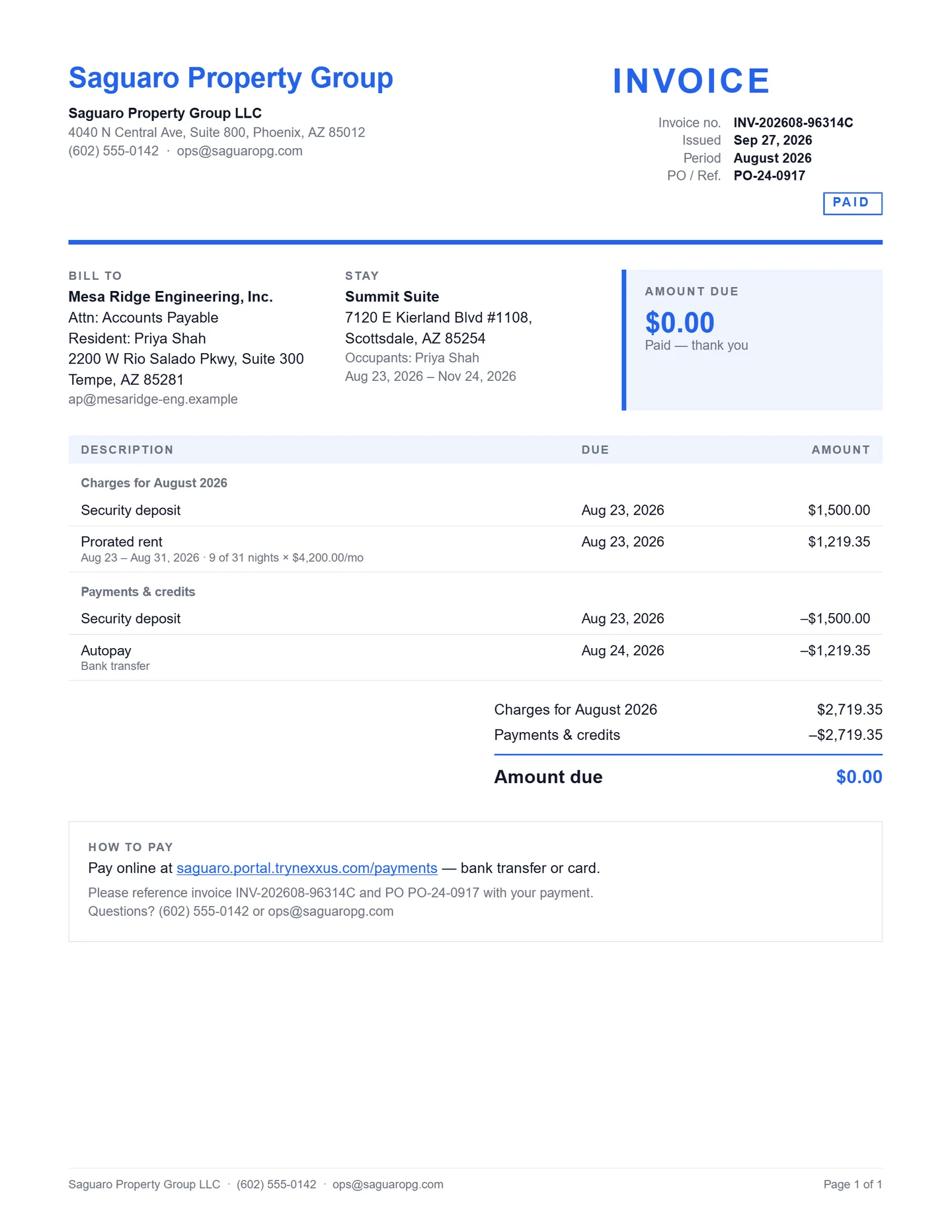
The exceptions were wires — the Italian team’s employer, and a home booked for a full year, paid up front by wire along with a month’s deposit. Those are the stays where a proper invoice matters: a PO number, the occupant, each month’s rent with the partial months prorated, and payment terms (Net 30 is common in corporate accounts payable). The corporate housing invoice template has a worked example. Businesses that pay you rent may also report it to the IRS — for payments after 2025, the Form 1099-MISC threshold for rents is $2,000 a year — so ask your CPA how that applies to you.
The companies that pay us mostly do it the easy way: their accounting team logs into our resident portal and pays the rent. The wires were the exceptions — and before we signed that contract, we made sure the company was real.
Running corporate stays in one system
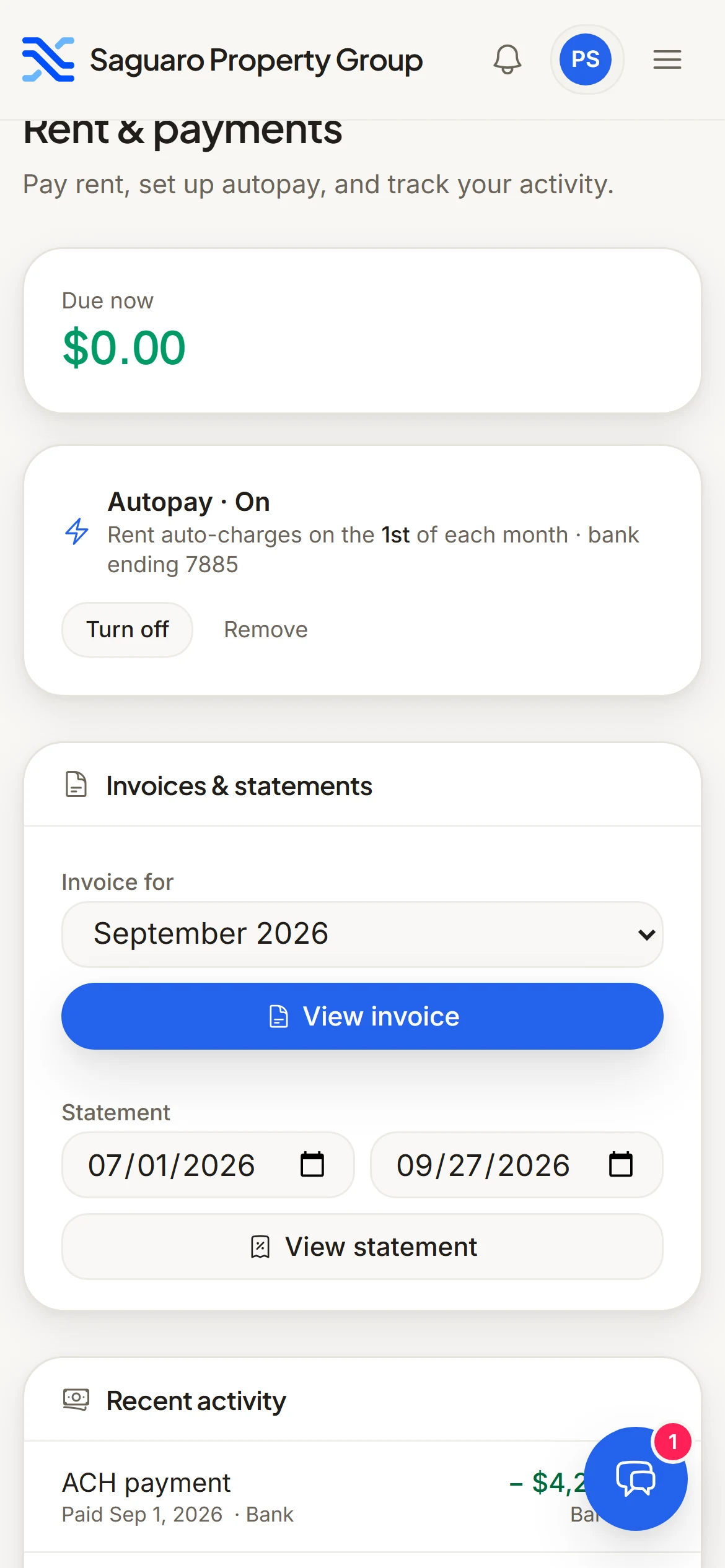
In Nexxus, rent is paid the way ours is: online in your branded resident portal, by bank transfer or card, with autopay. The stay’s rent is scheduled on the ledger for the whole stay — first and last months prorated by the day. Extend the stay and the new months post; shorten it and they come off. When a company pays a whole term up front, you record it once as a prepaid term, with the date the owner was paid, so owner payouts never pay that money twice.
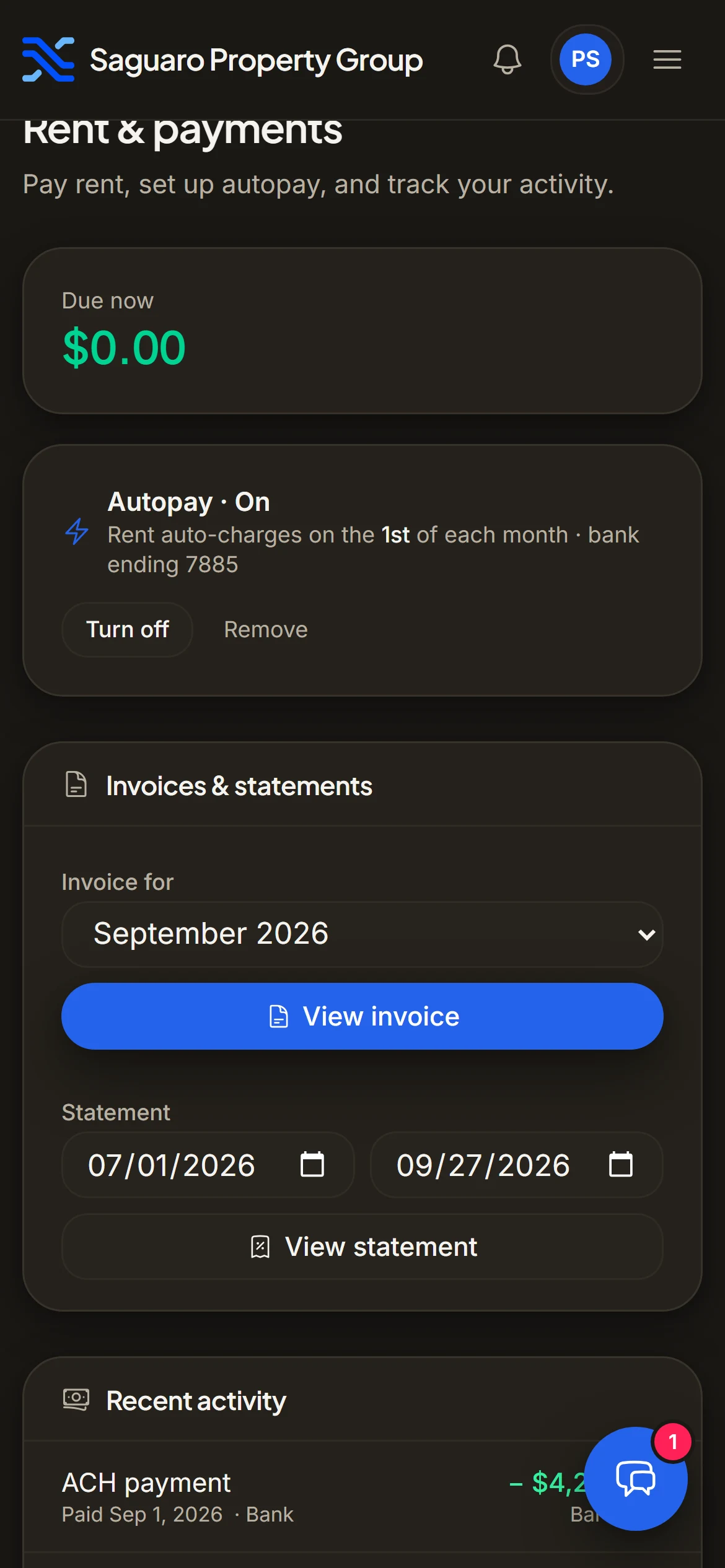
When the company needs paperwork, the invoice builds itself from the same ledger, with your logo, colors, legal name and address on it — billed to the company with its PO number, an Attn line and its accounts-payable email, and every partial month showing its nights. Email it to their accounts-payable inbox with the PDF attached, or let their accounting team download it — with a running-balance statement — from the portal’s Payments page when they pay there.
Every lease is e-signed and filed on the tenant’s record, and corporate stays sit on the same calendar as your Airbnb nights and yearly leases. Corporate housing, mid-term or medium-term rental — whatever your market calls it, it’s one calendar and one ledger.
See corporate housing software, or open the live demo set up for mid-term — no sign-up.
Corporate housing FAQ
How do I start a corporate housing business?
Start with one or two furnished homes near where people work — hospitals, plants, job sites, business districts — set up for a working professional, with utilities and Wi-Fi included. Get a lease written for 30+ night stays, insurance that covers furnished rentals, and a simple way for a company to pay. Then list where corporate travelers and their coordinators search, build your own site, and reach out to local employers directly.
How do I get corporate housing contracts with companies?
Mostly one stay at a time. Reach the people who place employees — HR, relocation, travel and project managers at local employers — and register as a supplier with relocation and housing companies that place people in homes. Answer fast, send clear photos and terms, and make paying easy for their accounting team. Repeat business follows good stays.
How do I rent my house to corporate housing companies?
Furnish it fully, include utilities and Wi-Fi, and offer stays of one month or more. Then list it where corporate travelers search, and register with relocation and corporate housing companies as a supplier — many look for local homes when they don’t have one in the area. Expect them to ask for photos, a W-9, your terms and proof of insurance.
What is a corporate lease?
A lease where a company is the tenant, or guarantees the rent, and one or more of its employees live in the home as named occupants. The company pays and is responsible under the lease; the occupants follow its rules. Have a landlord-tenant attorney write or review yours — this is general information, not legal advice.
How do companies pay for corporate housing?
Usually monthly in advance, like rent. Some employees pay their own rent and get reimbursed; some companies pay the landlord directly by bank transfer, card or wire; a few pay a whole term up front. Ours usually pay online through our resident portal — the company’s accounting team gets the login.
A “corporate housing company” messaged me about my rental. Is it real?
It may be — relocation and housing companies do look for local homes. Before you agree to anything, look the company up in its state’s business registry, call it back at a number you find yourself, and ask who the occupant is and how and when you’ll be paid. Walk away from anyone who wants to pay more than you asked and have you send the difference back.
How do I know a company is legitimate before I take its money?
Look the company up in the official business registry where it’s incorporated, call it back at a phone number you find yourself, have an authorized person sign, and for foreign companies check the US Treasury’s sanctions list. Confirm any bank-detail change by phone, and never refund an “overpayment” before a payment has truly cleared.
Sources
Checked September 26, 2026.
- Furnished Finder: 2026 pricing and FAQs (tenant groups and average stay, updated September 22, 2026)
- US Treasury, OFAC: Sanctions List Search and FAQ 18 (US persons are generally prohibited from dealing with listed parties)
- Arizona Corporation Commission: Arizona Business Center search
- FBI Internet Crime Complaint Center: business email compromise and “Business Email Compromise: The $55 Billion Scam”
- FTC: fake check scams
- IRS: instructions for Forms 1099-MISC and 1099-NEC and instructions for the requester of Form W-9
- Corporate Housing Providers Association and WERC (formerly Worldwide ERC)