
The short answer
Mid-term vs long-term, side by side
| Topic | Mid-term rental | Long-term rental |
|---|---|---|
| Typical stay | 1–12 months; most 2–6 | 12 months, then renewals |
| Furnished | Fully — furniture, kitchen, linens | Usually not |
| Utilities and Wi-Fi | Usually included in the rent | Usually the tenant’s |
| Who rents | Travel nurses, project crews, relocations, insurance stays | Households settling in |
| Rent | Higher per month — a furnished home, ready to live in | Market rent for an unfurnished home |
| Turnovers | Every few months | Once a year or less |
| Where it’s listed | Airbnb monthly, Furnished Finder, Zillow, your own site | Zillow and the long-term listing sites |
| Paperwork | A lease for every stay, with extensions | A yearly lease and renewals |
Rent, costs and vacancy
The mid-term premium is real, but it isn’t profit until you subtract what a long-term landlord doesn’t pay:
- Furnishing — everything from beds to a stocked kitchen, and replacing what wears out.
- Utilities and Wi-Fi — usually in your name and in the rent.
- Turnover — cleaning, linens and small repairs every few months instead of once a year.
- Vacancy — a gap between two mid-term tenants is common; plan for it in your price.
- Listing and management time — more inquiries, applications and move-ins every year.
We don’t publish our portfolio’s numbers, and yours will differ anyway. The mid-term rental calculator compares the same home as a nightly, monthly and yearly rental on your own rent, costs and vacancy.
Tenants and leases
Mid-term tenants are mostly people with a reason to be somewhere for a few months — in our homes, a fairly even mix of travel healthcare workers, construction crews and project managers, families between homes, insurance placements and relocations. Typical stays run two to six months, and a one-month stay often turns into more.
Both are tenancies, so both need a real lease and real screening. What changes is how often you do it: a mid-term operator signs leases, collects deposits and handles move-outs many times a year. We use a lease for every stay, with extensions allowed and 30 days’ notice to vacate. See mid-term lease agreements and applications and screening.
Rules and taxes
- Tenant law. In many states a stay of about 30 days or more can create a tenancy, so a mid-term tenant may have the same notice and eviction protections as a long-term one — see the 30-day rule.
- Lodging taxes. Long-term leases don’t pay lodging tax. Mid-term stays often don’t either — many states stop taxing lodging at 30 days — but some draw the line at 90 days, 180 days or six months. In Arizona, for example, stays of 30 days or more are residential rentals, and cities stopped taxing them on January 1, 2025. See transient occupancy tax.
- HOA and city rules. Some HOAs and cities set minimum lease terms or registration rules that treat furnished or shorter stays differently. Read yours before you convert.
- Insurance. Tell your insurer the home is furnished and rented for one to twelve months; a standard long-term landlord policy may not fit.
- Income tax. Under the federal passive-activity rules, a home whose average stay is longer than 30 days is a rental activity — the same as a long-term rental. The exceptions short-term hosts call “the STR loophole” apply only when the average stay is 7 days or less, or 30 days or less with significant personal services. Ask your CPA how it applies to you.
This is general information, not legal or tax advice.
The middle path: furnished yearly leases
It isn’t always one or the other. About 5–10% of our furnished homes are on yearly leases — and they rent at furnished rates, because the tenant is getting a furnished home. For an operator, that’s a year with no turnover in a home that’s already set up for mid-term; for the tenant, it’s a home they don’t have to furnish.
A furnished home on a yearly lease is still a furnished home, so we price it as one — not as an unfurnished long-term rental.
When each one wins
| Topic | Mid-term tends to win | Long-term tends to win |
|---|---|---|
| Location | Near hospitals, big employers, job sites, universities | Far from those, or mostly families settling in |
| The home | Easy to furnish and keep up; parking and laundry | Large family homes, or ones you don’t want furnished |
| Your time | You (or a manager) can handle move-ins every few months | You want one tenant and one lease a year |
| Rules | Your HOA and city allow 30+ night furnished stays | Minimum-term rules or an HOA that won’t |
Converting a long-term rental to mid-term
- Let the current lease end — or end it the way your state and the lease allow
- Check your HOA, city registration and any minimum-lease rules
- Update your insurance for a furnished rental with 1–12 month stays
- Furnish it for someone who lives and works there: a desk, a full kitchen, laundry, fast Wi-Fi
- Put utilities and internet in your name and decide what the rent includes
- Get a lease written for 1–12 month stays, with extensions and notice
- Price it against comparable furnished homes — not unfurnished rents
- List it where mid-term tenants search, and on your own site
What to buy, room by room, is in the free mid-term rental furnishing checklist. Where to list is in where to list mid-term rentals, and why a site of your own matters is in direct booking for mid-term rentals.
Running mid-term and long-term together
Most operators who go mid-term keep a few yearly leases — and some add nightly stays to fill the gaps. For years we ran that on Buildium, Airbnb and spreadsheets, and the calendars never quite matched. In Nexxus, monthly stays and yearly leases share one calendar and one ledger: rent for the whole stay is scheduled with partial months prorated by the day, extensions add months, and every lease is e-signed. Whether your market calls them mid-term, midterm or medium-term rentals, they sit next to your 12-month tenants.
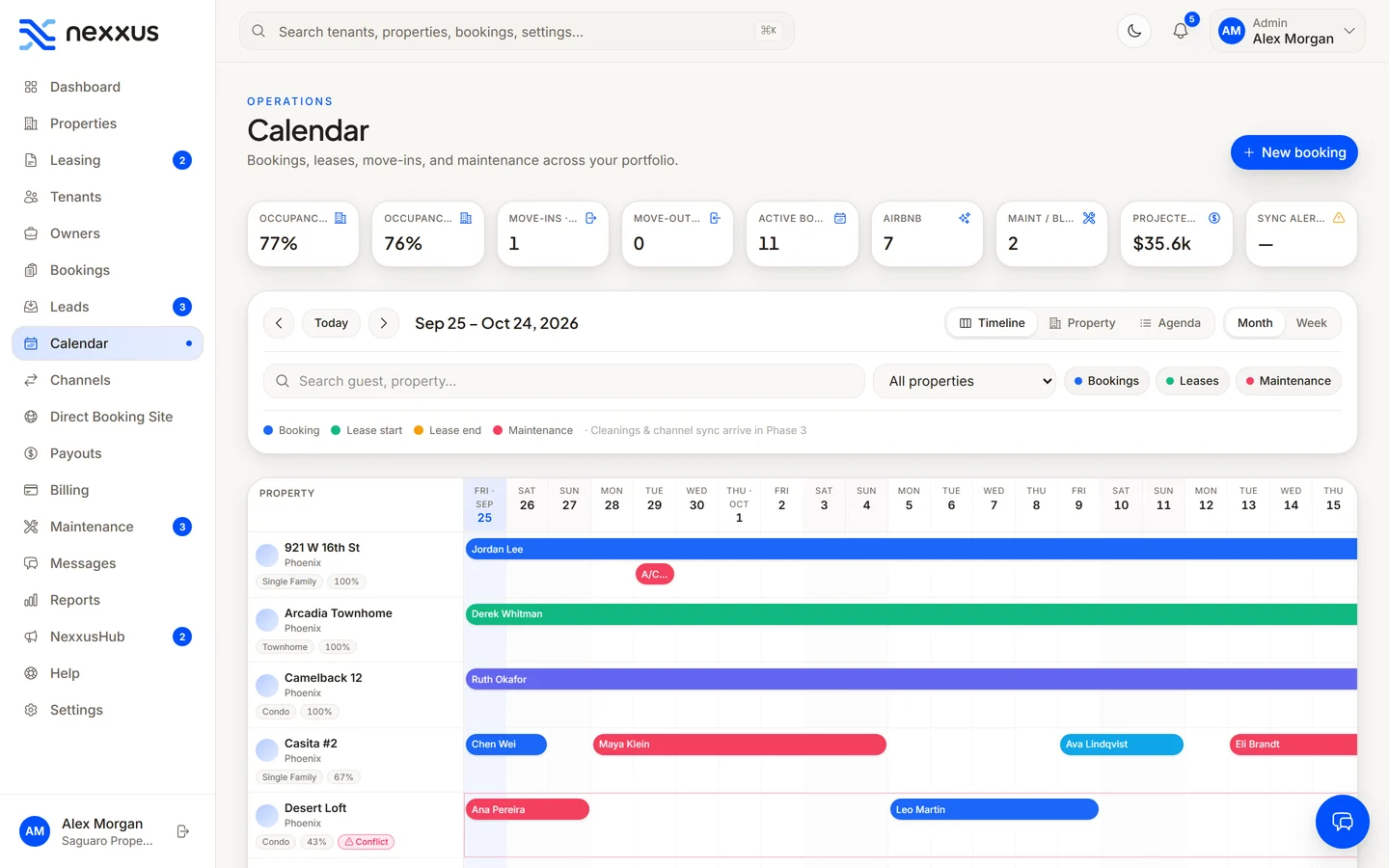
See mid-term rental software, or open the live demo set up for mid-term — no sign-up. For the three-way comparison with nightly rentals, see mid-term vs short-term rentals.
Mid-term vs long-term FAQ
Is a mid-term rental better than a long-term rental?
It can earn more, but it asks more. A furnished mid-term rental usually rents for more per month than the same home unfurnished on a yearly lease, and you pay for furniture, utilities, Wi-Fi, cleaning between tenants and more vacancy. Where there’s steady demand from traveling professionals, relocations and insurance stays, mid-term often comes out ahead; where there isn’t, a long-term lease is simpler.
What is the difference between a mid-term and a long-term rental?
Length, furnishing and who rents. A mid-term rental is furnished and rented for about one to twelve months — most stays run two to six — usually with utilities included. A long-term rental is typically unfurnished, on a 12-month lease, with the tenant paying most utilities.
Are mid-term rentals worth it?
For many operators, yes — especially near hospitals, large employers and job sites, or as a step down from nightly rentals. You trade some of a long-term lease’s simplicity for higher rent and a better-furnished product. Run your own numbers, including furnishing and vacancy, before you switch.
How do I convert a long-term rental to a mid-term rental?
Let the current lease end or end it lawfully, check your HOA and city rules, update your insurance for furnished rentals, furnish the home for someone who lives and works there, put utilities and Wi-Fi in your name, get a lease written for 1–12 month stays, then list it where mid-term tenants search and on your own site.
Do mid-term tenants have the same rights as long-term tenants?
Often, yes. In many states a stay of about 30 days or more can create a tenancy, with the same notice and eviction rules as any tenant. That’s why most mid-term operators use a written lease reviewed by an attorney. This is general information, not legal advice.
Can I rent a furnished home on a yearly lease?
Yes, and it’s a useful middle path. We put 5–10% of our furnished homes on yearly leases — priced as furnished homes, not as unfurnished rentals, because that’s what the tenant is getting.
Sources
General information, checked September 26, 2026. Confirm the rules for your state with an attorney and a CPA.
- Airbnb: things to consider before hosting monthly stays (tenancy after 30 consecutive days in some states)
- Arizona Department of Revenue: residential rental guidelines (no city tax on 30+ day stays from January 1, 2025)
- IRS: Publication 925 (passive activity and at-risk rules) and the Form 8582 instructions (rental-activity exceptions: average customer use of 7 days or less, or 30 days or less with significant personal services)