
The short answer
What a mid-term manager does
A mid-term rental — sometimes written midterm, or called a medium-term rental — is a furnished home rented by the month to travel nurses, project crews, relocating families and households displaced by an insurance claim. Managing one is closer to running a small hotel with leases than to collecting rent once a year. A full-service manager usually takes on:
- Leasing. Listing the home where mid-term tenants look, answering inquiries the same day and showing it — see where to list mid-term rentals.
- Screening and leases. Applications, checks applied the same way to everyone, and a lease for every stay — see applications and screening.
- Rent and deposits. Collecting the deposit and move-in money, monthly rent with partial months prorated, and extensions.
- Turnovers. A deep clean, a check against the move-in record and a safety reset every few months — see the cleaning checklist.
- Repairs and utilities. Maintenance requests, vendors, and keeping utilities and Wi-Fi running in the owner’s name.
- Owner statements and payouts. What came in, what went out, the fee, and the net paid to the owner — see owner statement.
| Topic | Nightly (short-term) | Monthly (mid-term) | Yearly (long-term) |
|---|---|---|---|
| The core job | Pricing, guest messages and a clean after every stay | Leasing, screening and a turnover every few months | Leasing once a year, rent and repairs |
| Paperwork | The platform’s booking terms | A lease for every stay, with extensions | A yearly lease and renewals |
| Furnishings | Kept up and restocked | Kept up and counted at every move-in | Usually none |
| How the fee is usually set | A share of booking revenue | A share of rent, sometimes plus a fee per tenant | A share of rent, plus a leasing fee per new tenant |
| Managing for others in Arizona | Booking stays of 31 days or fewer is exempt | Longer stays fall outside that exemption | Leasing and collecting rent for others needs a license |
How mid-term managers charge
There’s no standard fee. Managers mix a few common models, and the percentage alone doesn’t tell you what you’ll net — the extras do. The models, and what to ask about each:
| Topic | How it works | What to ask |
|---|---|---|
| Monthly management fee | A percentage of the rent collected each month — the most common model | Rent collected or rent scheduled? Does it apply to cleaning fees, deposits or utility charges? |
| Leasing or placement fee | A fee each time a new tenant moves in; some mid-term managers fold it into the monthly percentage | With a new tenant every few months, is there a fee per tenant — and per extension? |
| Setup or onboarding | A one-time fee for photos, listings and getting the home ready | What it covers, and what happens to it if you leave early |
| Furnishing project | A one-time fee to furnish and set up a home for mid-term stays | Who owns the furniture, and how purchases are billed |
| Turnover cleaning | Charged to the tenant as a cleaning fee, billed to you, or inside the monthly fee | Who pays for the clean between tenants, and who checks it |
| Maintenance | Repairs billed at cost, or with a markup or coordination fee | Is there a markup, and what amount needs your approval first? |
| Flat or minimum fee | A fixed monthly fee instead of a percentage, or as a floor under one | What you pay in a month the home sits empty |
| Ending the agreement | Notice terms, and sometimes a cancellation fee | What happens to current tenants, deposits and records when you leave |
One operator’s numbers. Tyler Sorenson, Nexxus’s founder, has managed furnished homes for owners for years. What the founder has found works is a management fee of about 15% for mid-term stays, down to 10% for furnished yearly leases — whose rents, by the founder’s estimate, typically run 50–100% above the same home unfurnished. That’s one operator’s experience, not a standard: every manager sets its own fees, and no owner or manager is held to these. Furnished yearly leases are covered in mid-term vs long-term rentals, and how the fee is set and what it covers in management fee.
Questions to ask a mid-term manager
- Are you licensed where my home is — and can I look the license up on the state regulator’s site?
- How many furnished mid-term homes do you manage, and what’s your typical stay length and gap between tenants?
- Where will you list my home, and how fast do you answer inquiries?
- How do you screen applicants, and do you treat every applicant the same way?
- Who cleans between tenants, who checks the clean, and who pays for it?
- Where are the rent and the deposit held until they reach me — a trust account?
- How often will I get a statement and a payout, and what’s on the statement?
- What fees could I pay in a year — leasing, setup, extensions, maintenance markups, vacant months?
- Up to what repair amount do you act without asking me?
- Who insures what — my policy, yours and the tenant’s?
- How do I end the agreement, and what happens to tenants, deposits and records if I do?
- Can I see my statements, payouts and documents online, any time?
What the management agreement should spell out
Put the whole arrangement in writing, and have a real-estate attorney review it before you sign — Nexxus doesn’t publish agreement templates. Some states list what a property management agreement must contain. Arizona’s list, for example, requires the agreement to:
- state all the material terms of the manager’s services, duties and responsibilities to the owner;
- give a beginning and an ending date, and cancellation terms both sides agree to;
- say how all money the manager collects is handled, including tenant deposits;
- specify the type and frequency of reports to the owner;
- state any money held as an operating reserve, and why; and
- state the compensation the owner pays.
Who insures what. The agreement should also spell out who insures what: the owner’s policy on the home and its furnishings, the manager’s own coverage, and what the tenant should carry for their belongings, which a landlord’s or management company’s policy won’t cover. California’s real-estate regulator suggests owners find out what insurance or bond a management company carries. What to ask your own insurer is in mid-term rental insurance.
When managing for others needs a license
Many states treat renting out someone else’s home and collecting the rent for pay as real-estate brokerage. Arizona’s rules show how it works — and one detail that matters for mid-term:
| Topic | What the law says |
|---|---|
| Who needs a license | A broker is a person who, “for another and for compensation,” rents or leases real estate, offers to, or collects rent for it (A.R.S. 32-2101); doing so without a license is unlawful (32-2122) |
| Your own homes | Owners renting and managing their own property are exempt, as long as they take no property management fees for it (32-2121(A)(1)) |
| Short stays | A person who, on behalf of another, arranges or accepts reservations or money for occupancies of 31 or fewer days is exempt (32-2121(A)(15)) — most mid-term stays run longer |
| Owners’ money | A licensed firm keeps owners’ money in a trust account, or the owner’s own account, and deposits it within three banking days (32-2174) |
Asked “May I practice Property Management without a license?”, the Arizona Department of Real Estate tells people to seek legal advice and read the exceptions in A.R.S. 32-2121 — good advice in any state. Other states draw similar lines; California’s definition of a broker includes leasing, renting or collecting rents for others for compensation (Business and Professions Code 10131). Before you hire, look the manager up on your state regulator’s public license database. This is general information, not legal advice. How owners’ money is held is in trust account.
Self-manage or hire a manager?
| Topic | Self-manage | Hire a manager |
|---|---|---|
| What it costs | Your time, plus software and local help | A share of the rent, plus any setup, leasing and maintenance fees |
| Inquiries | You answer them — the same day, because mid-term leads message several homes | The manager answers them |
| Turnovers and repairs | A cleaner and a handyman you trust, near the home | The manager’s vendors |
| Money | Rent comes to you | Rent goes to the manager, then to you on a statement, less fees |
| License | Usually none for your own homes — Arizona exempts owners | The manager’s, where your state requires one |
| Best when | You’re close by, have a few homes and like running them | You’re far away, have more homes than hours, or would rather not |
Self-managing from a distance works with help on the ground: a reliable cleaner, a handyman, a keypad lock so codes change between tenants, and one system for the calendar, leases and rent. If you’re starting from scratch, the ten steps are in how to start a mid-term rental.
Running it in one system
Whichever side you’re on, the work is the same — leases, rent, turnovers and, when there’s an owner, a statement every month. Nexxus runs it for one home you self-manage or a portfolio you run for owners.
Self-managing. Airbnb connects through Channex, an Airbnb Preferred+ Software Partner, so monthly stays booked there sit on one calendar with your own leases. Leases are e-signed, rent and deposits are paid online with autopay, and tenants send maintenance requests and pay from your resident portal. See Nexxus for self-managing landlords.
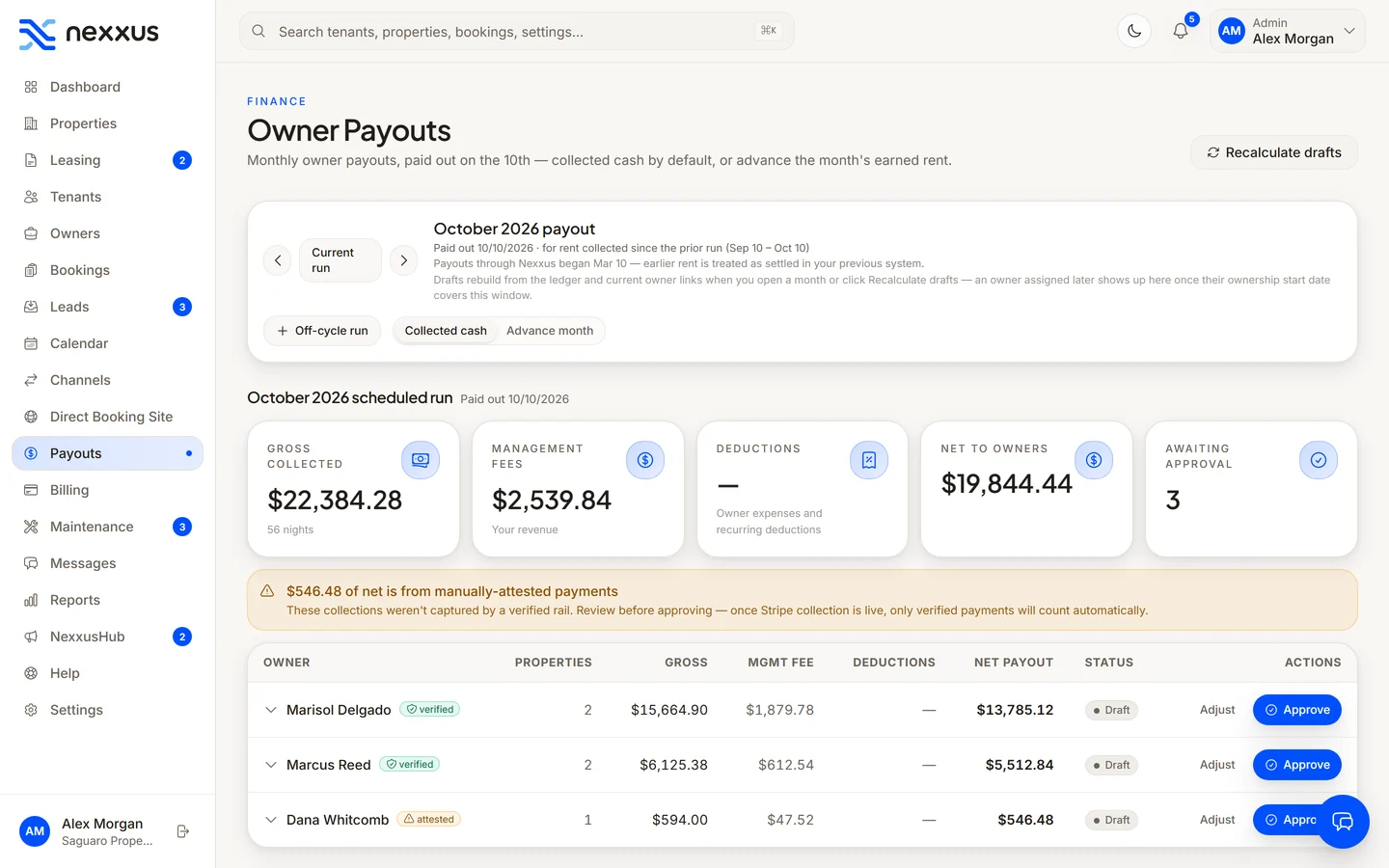
Managing for owners. Set your management fee as a company default, for each owner’s property, or on a single booking — say, a lower rate on a year-long lease. Each owner’s payout is drafted from the rent that actually came in, minus your fee and any deductions, and every line opens to the ledger rows behind it. You approve each payout and record how it was sent, and owners see their statements, payouts and documents in their own portal. At year end, the owner 1099-MISC worksheet totals each owner’s gross rents.
See mid-term rental software, open the live demo set up for mid-term — no sign-up — or see Nexxus plans and pricing.
Mid-term rental property management: FAQ
How much do mid-term rental property managers charge?
Most charge a percentage of the rent they collect, and some add a leasing fee per tenant, a setup fee, extension fees or a markup on repairs. Nexxus founder Tyler Sorenson has found that about 15% works for mid-term stays, dropping to 10% for furnished yearly leases — one operator’s experience, not a standard. Get every fee in writing and compare what you would net, not just the percentage.
Why do mid-term managers charge more than long-term managers?
There’s more work in each year: a new lease, move-in and deep-clean turnover every few months, furnishings to keep up and inventory, utilities and Wi-Fi to run, and more inquiries to answer. Many managers price mid-term between long-term and nightly management for that reason.
Do mid-term rental managers charge a placement fee?
Some fold placement into the monthly percentage; others charge a leasing fee each time a new tenant moves in. With a new tenant every few months, ask whether each tenant — and each extension — triggers a fee.
Do I need a license to manage someone else’s mid-term rental?
In many states, yes. Arizona, for example, treats renting or leasing real estate and collecting rent “for another and for compensation” as brokerage that requires a license. Its exemption for booking stays of 31 days or fewer doesn’t cover longer stays, and owners managing their own homes are exempt. Check your state real-estate regulator and an attorney — this is general information, not legal advice.
Should I self-manage my mid-term rental or hire a manager?
Self-manage if you live near the home, have a few homes and the time to answer inquiries the same day and run move-ins every few months — with a reliable local cleaner and handyman. Hire a manager if you’re far away, have more homes than hours, or would rather not do the work; compare what you’d net under their fees.
Can you manage a mid-term rental remotely?
Yes, with help on the ground: a cleaner you trust for turnovers, a handyman for repairs, a keypad lock so you can change codes between tenants, and software that keeps your calendar, leases and rent in one place. Answer inquiries quickly — mid-term tenants message several homes at once.
What should a property management agreement include?
At least the services and duties, the start and end dates, how either side can cancel, how rent and deposits are handled, what reports the owner gets and how often, any reserve the manager holds, all fees, and who insures what. Arizona, for example, requires most of those in writing. Have an attorney review yours.
Sources
Read on the official sites on October 7, 2026. Laws change — check the current versions and ask an attorney.
- Arizona Revised Statutes: 32-2101 (definitions), 32-2121 (exemptions), 32-2122 (license required), 32-2173 (property management agreements) and 32-2174 (trust accounts)
- Arizona Department of Real Estate: Auditing & Investigations FAQ and the public license database
- California Business and Professions Code 10131; California Department of Real Estate, quick guide for landlords
- NAIC: renting out your home and renters insurance
- Airbnb: software partners (Channex, Preferred+)