
The short answer
What Airbnb calls a monthly stay
On Airbnb, a monthly stay is any reservation of 28 nights or more — the same homes as nightly stays, with different pricing, payment and cancellation rules. It’s a big slice of Airbnb: stays of 28 nights or more made up 21% of nights booked in 2022 and 18% in early 2023, by Airbnb’s own numbers.
For hosts running a midterm business, that makes Airbnb both a booking engine and a lead source. A one-month stay often gets a guest in the door — and then they extend.
Settings to change before you take monthly stays
- Raise the maximum trip length. If you don’t set a maximum, Airbnb applies 31 nights automatically.
- Set a monthly discount (Calendar → Price settings → Discounts). Discounts of 10% or more show in search; ours is about 15–20% off nightly.
- Choose a long-term cancellation policy — it’s separate from your short-term one, and changes apply only to future reservations.
- Disclose any lease or contract in the listing description before anyone books.
- Check advance notice and preparation time so a long stay doesn’t collide with a turnover.
- Decide who can book — Airbnb lets you add guest requirements beyond its own.
How guests pay and how you get paid
| Topic | What happens |
|---|---|
| Guest, at booking | Pays the first month |
| Guest, after that | Pays monthly, ahead of each month of the stay |
| Your first payout | By the end of the business day after check-in (28 days after check-in for new hosts with fewer than two completed stays) |
| Your later payouts | Monthly, for the rest of the stay |
Monthly payments help cash flow, but they also mean a long stay is paid a month at a time, not up front. Track what each month paid out against the stay, not just the booking total.
Long-term cancellation policies
Stays of 28 nights or more use a long-term cancellation policy you choose separately from your short-term one:
| Topic | Full refund if the guest cancels | After that, you’re paid for |
|---|---|---|
| Firm | At least 30 days before check-in | All nights stayed, plus 30 more nights |
| Strict | Within 48 hours of booking, and at least 28 days before check-in | The nights stayed, plus the next 30 nights |
Either way, once the refund window has passed, a cancellation pays you for the nights stayed plus about the next 30 — not the rest of a long booking. That lines up with how many mid-term operators write their leases: ours requires 30 days’ notice to vacate, and we refund dates we re-rent.
Fees on monthly stays
Airbnb has been moving hosts to a single service fee: most hosts pay 15.5%, taken from the payout, and the older split fee (about 3% for the host plus a guest fee) is being phased out. On a monthly stay that’s real money, which is why many operators also use lead sites with flat fees — Furnished Finder charges $199 a year per listing with no commission — and their own website. Set your monthly price so what you keep is about the same on every channel.
The 30-day tenancy question
This is the part of monthly stays that surprises hosts. Airbnb’s own guidance for US hosts says that in California, Illinois and New York, a residential tenancy may be created after 30 consecutive days — which can mean a court eviction to remove a guest who won’t leave, and local rent-control rules may apply. Airbnb’s terms call a booking a limited license to use the home, but also say landlord-tenant laws may apply to longer stays.
Other states draw the line differently, and courts often look at more than the day count. The practical answer most mid-term operators land on: treat a monthly guest like a tenant, with a written lease reviewed by an attorney. What that lease should cover is in mid-term lease agreements.
Leases, deposits and damage
- Leases and contracts. You can ask guests to sign a contract if you disclose its terms in your listing description before booking and send the full terms in the message thread. If it wasn’t disclosed before they booked, the guest can decline and cancel for a full refund — and Airbnb won’t help enforce your contract’s special policies.
- Security deposits. Most hosts aren’t allowed to charge one, and asking for payments outside Airbnb breaks its rules. A small number of software-connected hosts can collect disclosed deposits.
- Damage. Claims go through Airbnb’s Resolution Center and AirCover for Hosts, which has deadlines measured from checkout and excludes normal wear and tear — which adds up over a three-month stay. Document the home’s condition at check-in and check-out.
- Taxes. Whether Airbnb collects occupancy tax, and whether stays of 30+ nights are exempt, depends on the state and city. Check yours with your tax adviser.
Who you’re renting to
Airbnb requires identity verification from every guest who books, and it runs background checks on some US users — but, in its own words, not on all of them. Hosts don’t receive a credit or background report, and Airbnb limits asking guests for ID photos outside its process. What you can do: set guest requirements, read reviews from past hosts, ask about the purpose of the stay in messages, and — for longer stays — use a disclosed lease. For stays you take directly, see mid-term applications and screening.
Running Airbnb monthly stays next to everything else
Airbnb is where nightly and monthly guests meet on the same home — a two-night weekend can sit right before a three-month stay, and a direct lease can start the day an Airbnb stay ends. Keeping those on separate calendars is how double bookings happen.
Roughly half our stays come through Airbnb, and a one-month stay often gets someone in the door — then they extend. The hard part was never Airbnb; it was keeping Airbnb, our own site and every lease on one calendar and one set of books.
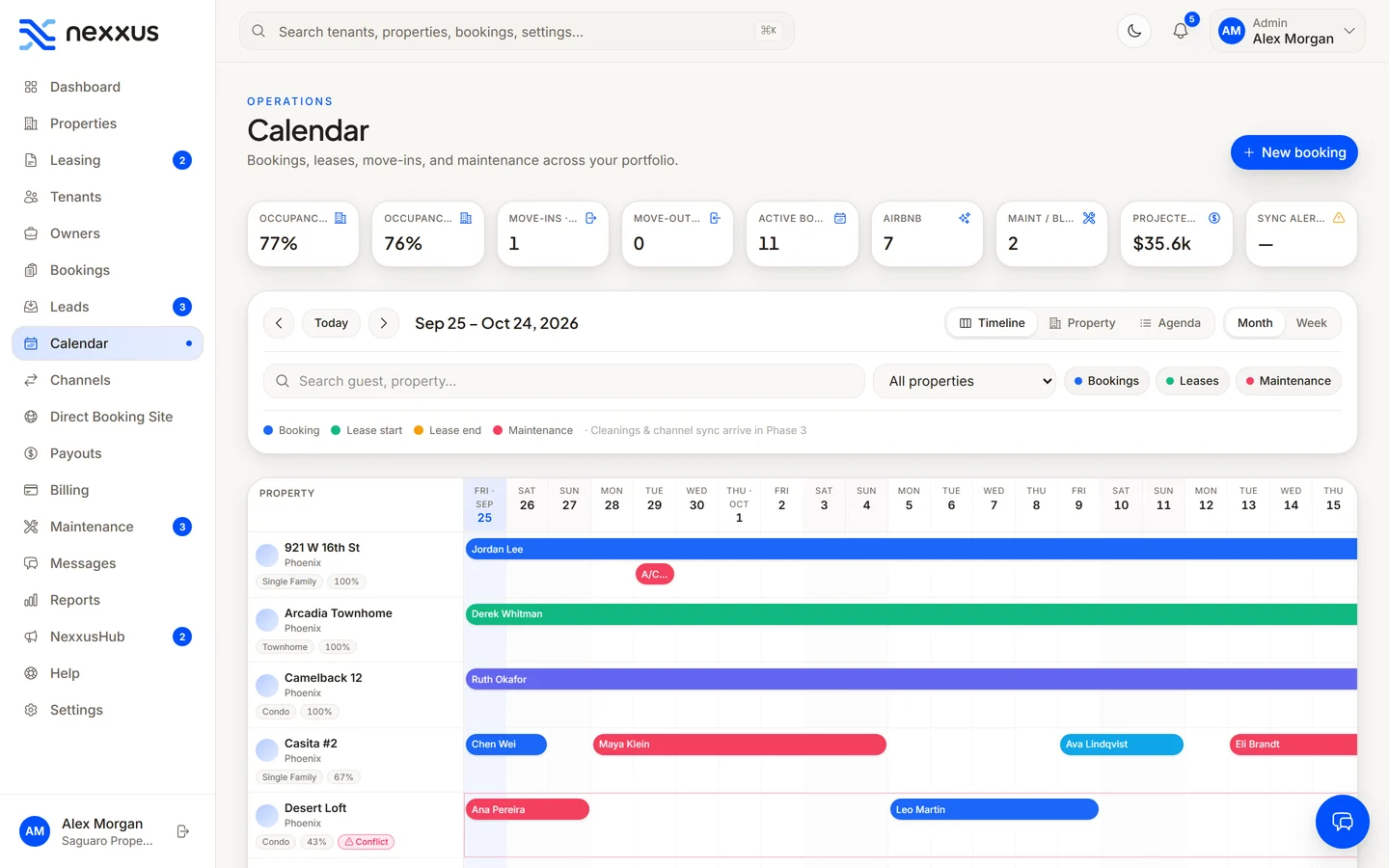
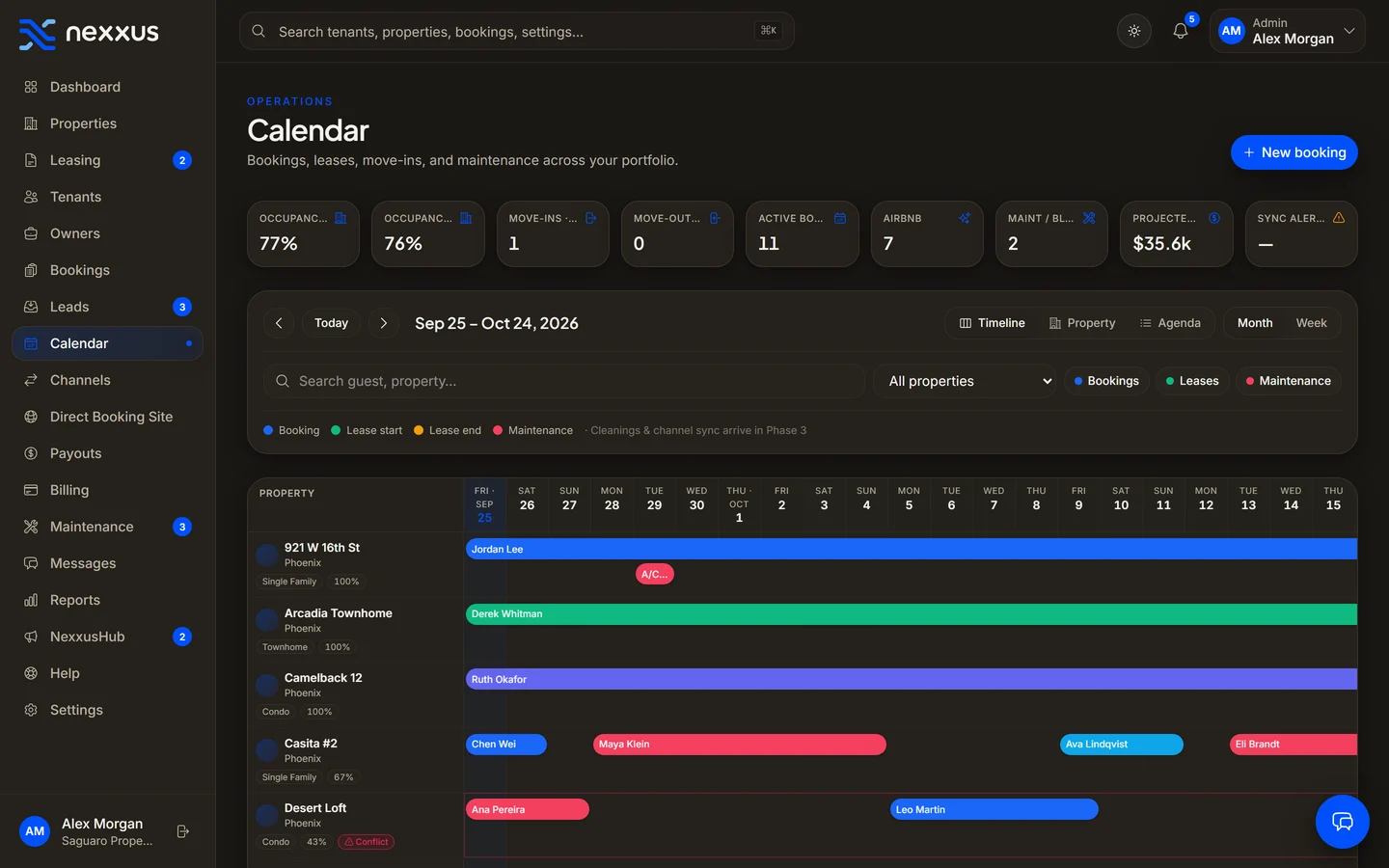
Nexxus syncs Airbnb listings, reservations and calendars, so Airbnb stays sit on the same calendar as your direct bookings and leases, and every stay lands on the same owner statement. See mid-term rental software, or open the live demo set up for mid-term — no sign-up. Some markets call these medium-term rentals; Airbnb just calls them monthly stays.
Airbnb monthly stays: FAQ
Can you list a mid-term rental on Airbnb?
Yes. Airbnb treats any stay of 28 nights or more as a monthly stay. You don’t need a separate listing: set a monthly discount, raise your maximum trip length above Airbnb’s automatic 31 nights, and choose a long-term cancellation policy. About half of our stays come through Airbnb this way.
What is Airbnb’s 30-day rule?
People use it for two things. Airbnb’s own guidance says that in California, Illinois and New York a residential tenancy may be created after 30 consecutive days — so removing a guest who won’t leave could take a court eviction. And some cities treat rentals of 30 days or more differently from short-term rentals, which is why hosts there set a 30-night minimum. Check your state and city rules with an attorney.
How does Airbnb pay hosts for monthly stays?
The guest pays the first month when they book and the rest monthly. Airbnb releases your first payout by the end of the business day after check-in — or 28 days after check-in for new hosts with fewer than two completed stays — and then pays you monthly for the rest of the stay.
What is Airbnb’s long-term cancellation policy?
For stays of 28 nights or more you pick one of two long-term policies. Firm: a full refund if the guest cancels at least 30 days before check-in; after that you’re paid for the nights stayed plus 30 more nights. Strict: a full refund only within 48 hours of booking and at least 28 days before check-in; after that you’re paid for the nights stayed plus the next 30 nights.
Can I charge a security deposit for a monthly Airbnb stay?
Most hosts can’t. Airbnb’s policy says most hosts aren’t allowed to charge a security deposit and payments outside Airbnb aren’t allowed; a small number of software-connected hosts may collect disclosed deposits. For damage, hosts use Airbnb’s Resolution Center and AirCover for Hosts, which has deadlines measured from checkout.
Can I make an Airbnb guest sign a lease?
You can require a contract if you disclose its terms in your listing description before booking and send the full terms in the message thread. If you didn’t disclose it before they booked, the guest can decline to sign and cancel for a full refund — and Airbnb won’t enforce your contract’s special terms.
How much of a monthly discount should I give on Airbnb?
Enough to compete with furnished monthly rents near you, not with nightly rates. We set ours at about 15–20% off the nightly price. Discounts of 10% or more show in Airbnb search, and Airbnb sometimes adds its own monthly-stay savings on top, paid by Airbnb rather than taken from your payout.
Sources
Read on Airbnb’s Help Center and Resource Center on September 26, 2026. Airbnb changes its fees and policies — check the current articles.
- Airbnb Help Center: host monthly stays, weekly and monthly discounts, minimum and maximum trip length, how guests pay for long stays, when you’ll get your payout, cancellation policies, service fees
- Airbnb Help Center: things to consider before hosting monthly stays, guest contracts, off-platform and fee transparency policy, AirCover for Hosts damage protection terms, identity verification, criminal convictions and background checks, Terms of Service
- Airbnb Resource Center: setting a price for longer stays (share of nights booked in stays of 28+ nights)